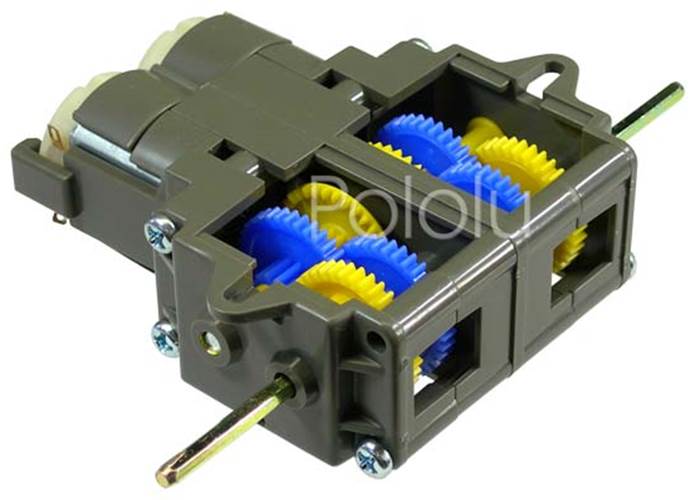
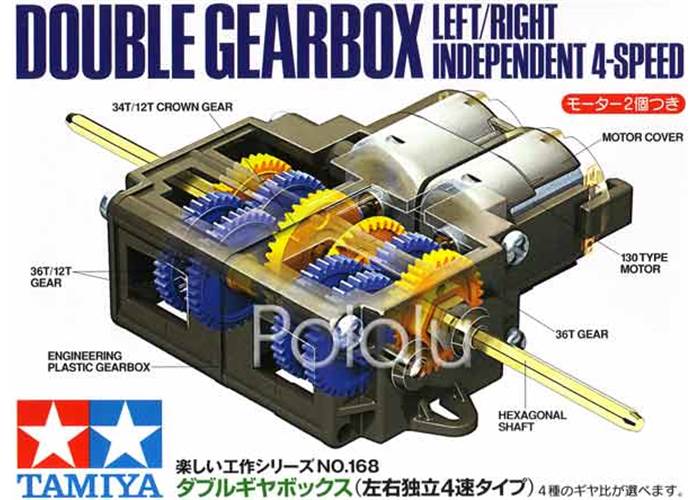
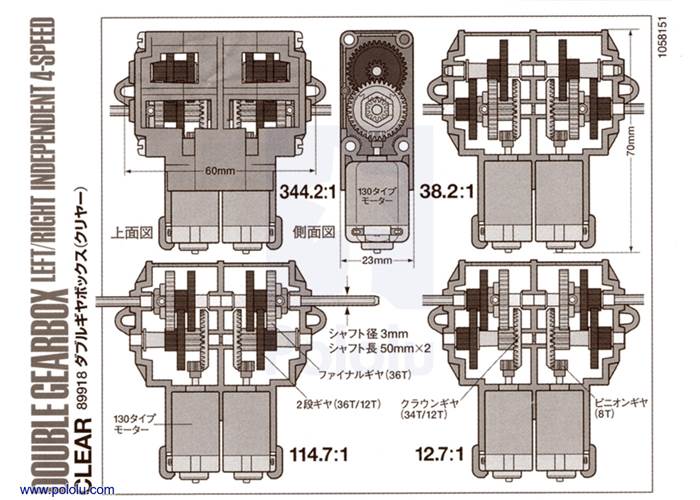
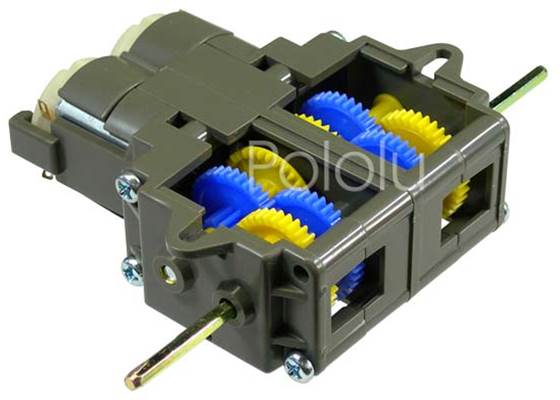
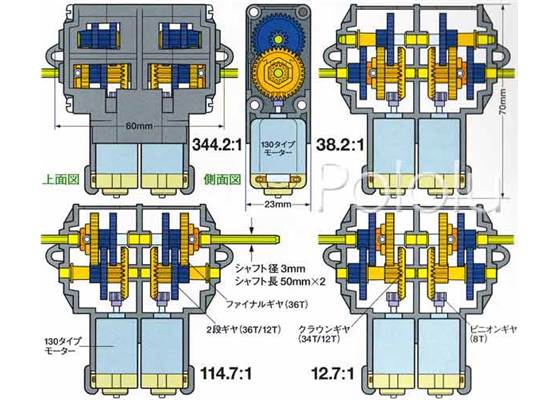
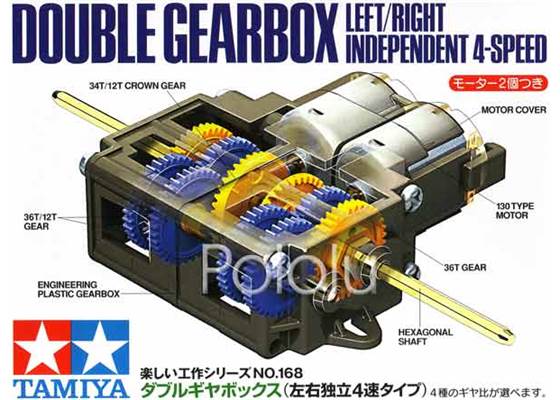
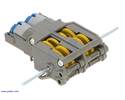
Tamiya’s double gearbox packs two independent gear trains into a compact and affordable package that is great for small mobile robots. Each side can be assembled to have one of four gear ratios: 12.7:1, 38:1, 115:1, or 344:1.
Special Order
Shipping from $9.90
+89 more from our supplier in 7-10 days
Our Code: MEC-30050
Supplier Link: [Pololu MPN:114]
Tamiya’s double gearbox packs two independent gear trains into a compact and affordable package that is great for small mobile robots. Each side can be assembled to have one of four gear ratios: 12.7:1, 38:1, 115:1, or 344:1.

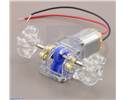
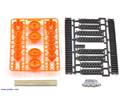
Tamiya 70168 double gearbox kit – clear.
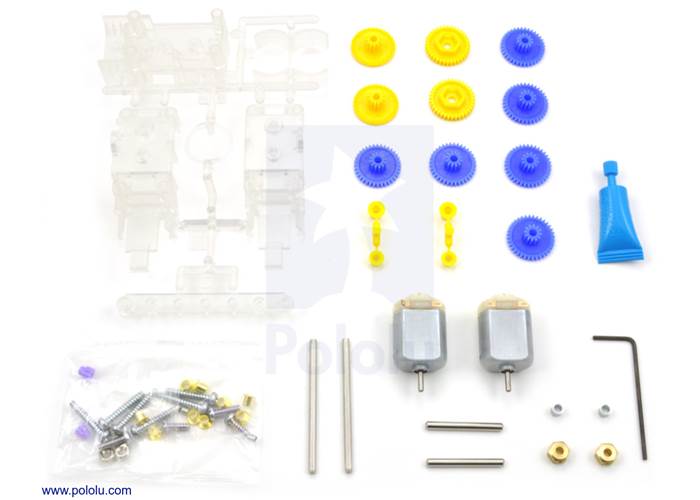
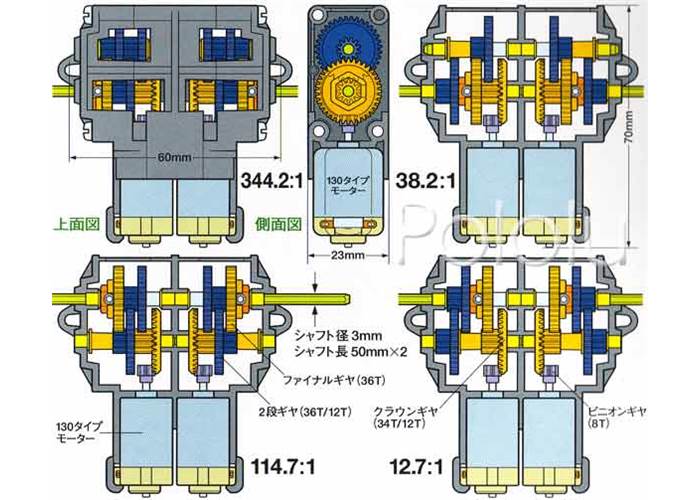
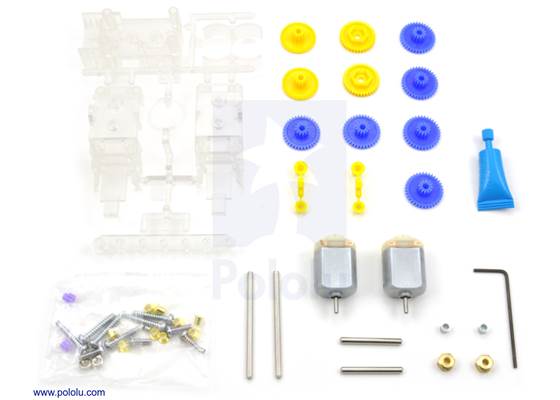
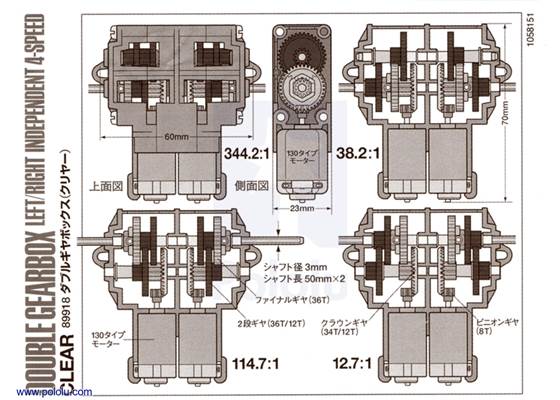
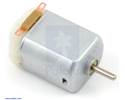
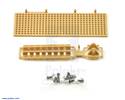
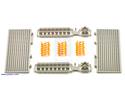
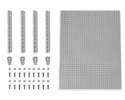
The Tamiya double gearbox is a compact unit with two independent motors and gear trains. The kit includes two motors and all gears and parts to build any of the four possible gear ratio configurations (12.7:1, 38:1, 115:1, and 344:1). Although it is not typical, it is possible to assemble each side with different gear ratios. There are two possible output axle locations (for any given gear ratio, only one output location is possible).
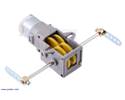
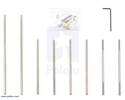
The output shafts included in this kit are 3 mm hexagonal axles that are 10 cm (about four inches) from tip to tip. The axles work with any of the Tamiya wheels we carry, giving you many options for your robot speed. The low-voltage motors run on 3-6 volts and draw up to a few amps, making them perfect candidates for the DRV8833 motor driver carrier. Motor overheating can be caused by excessive stalling, even at very low voltages. We recommend that you use stall-detection sensors, or just watch your robot, to make sure that it doesn’t stall for more than a few seconds at a time. For motor specs, see the Mabuchi motor FA-130 (#18100) data sheet (58k pdf).
Note that you can replace the motor in this kit with a lower-current, higher-voltage motor if you want to use this gearbox with controllers such as the TB6612FNG dual motor driver carrier or Baby Orangutan B-328 robot controller.

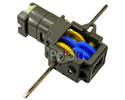
Tamiya 70168 double gearbox (left) and Tamiya 70097 twin-motor gearbox (right).
The double gearbox is very similar to the Tamiya 70097 twin-motor gearbox, as shown in the picture to the right. The gear ratio options of the two products complement each other well, but the mounting holes and overall dimensions vary slightly. The double gearbox is shorter and wider than the twin-motor gearbox, and the gears are a bit smaller and wider. This should make the double gearbox a bit more robust, though we have not heard any reports of the twin-motor gearbox gears breaking.
To compare all Tamiya gear box kits, see the Tamiya Gearbox Gear Ratio Comparison.
Note: The double gearbox is a kit; assembly is required. To use the kit in robotics projects, you need to connect the motors to your own robot controller.
| Typical operating voltage: | 3 V |
|---|---|
| Gear ratio options: | 12.7, 38, 115, 344 :1 |
| No-load motor shaft speed @ 3V: | 12300 rpm1 |
| No-load current @ 3V: | 150 mA2 |
| Stall current @ 3V: | 2100 mA |
| Motor shaft stall torque @ 3V: | 0.5 oz·in3 |
| Colour: | grey |
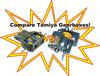
Table comparing the gear ratios available in the many different Tamiya gearboxes we carry.
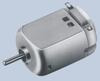
Adam, who posts under the username nexisnet on the Pololu forums, has performed a detailed series of experiments to determine how operating voltage affects the lifetime of the Mabuchi FA-130 motor, which happens to be the motors used in the Tamiya 70168 Double Gearbox, 70167 Single Gearbox (4-Speed), 70097 Twin-Motor Gearbox, 70093 3-Speed Crank-Axle Gearbox, 70110 4-Speed Crank-Axle Gearbox, and 70103 Universal Gearbox.

 Brands