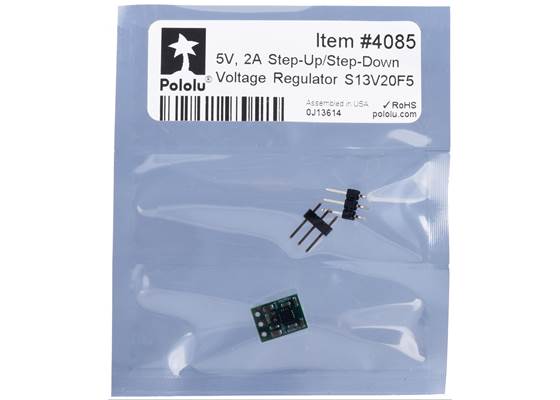
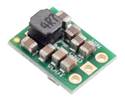
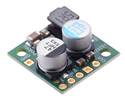
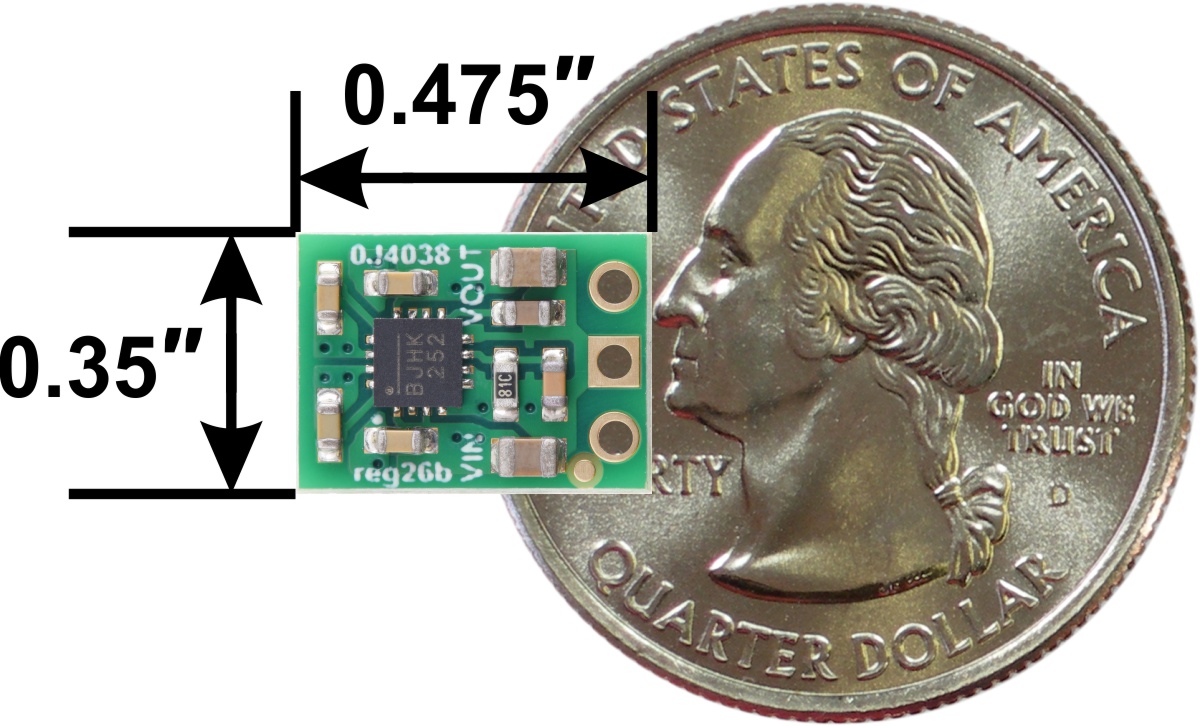
Output voltage Typical max output current * Input voltage range Size Optional enable input Reverse voltage protection 5 V 2 A 2.8 V – 22 V 0.35″ × 0.475″ – – * For input voltages close to the output.
Special Order
Shipping from $2.90
+287 more from our supplier in 7-10 days
Our Code: SKU-008099
Supplier Link: [Pololu MPN:4085]
| Output voltage | Typical max output current* |
Input voltage range | Size | Optional enable input |
Reverse voltage protection |
|---|---|---|---|---|---|
| 5 V | 2 A | 2.8 V – 22 V | 0.35″ × 0.475″ | – | – |
*For input voltages close to the output. Actual achievable maximum continuous current is a function of input voltage and is limited by thermal dissipation. See the output current graphs on the product page for more information.
 |
The S13VxF5 family of efficient switching regulators (also called switched-mode power supplies (SMPS) or DC-to-DC converters) use a buck-boost topology to convert both higher and lower input voltages to a regulated 5 V output. They take input voltages from 2.8 V to 22 V and increase or decrease them as necessary, offering a typical efficiency of over 85% and typical continuous output currents between 1 A and 3 A . The flexibility in input voltage offered by this family of regulators is especially well-suited for battery-powered applications in which the battery voltage begins above 5 V and drops below as the battery discharges. Without the typical restriction on the battery voltage staying above the required voltage throughout its life, new battery packs and form factors can be considered.
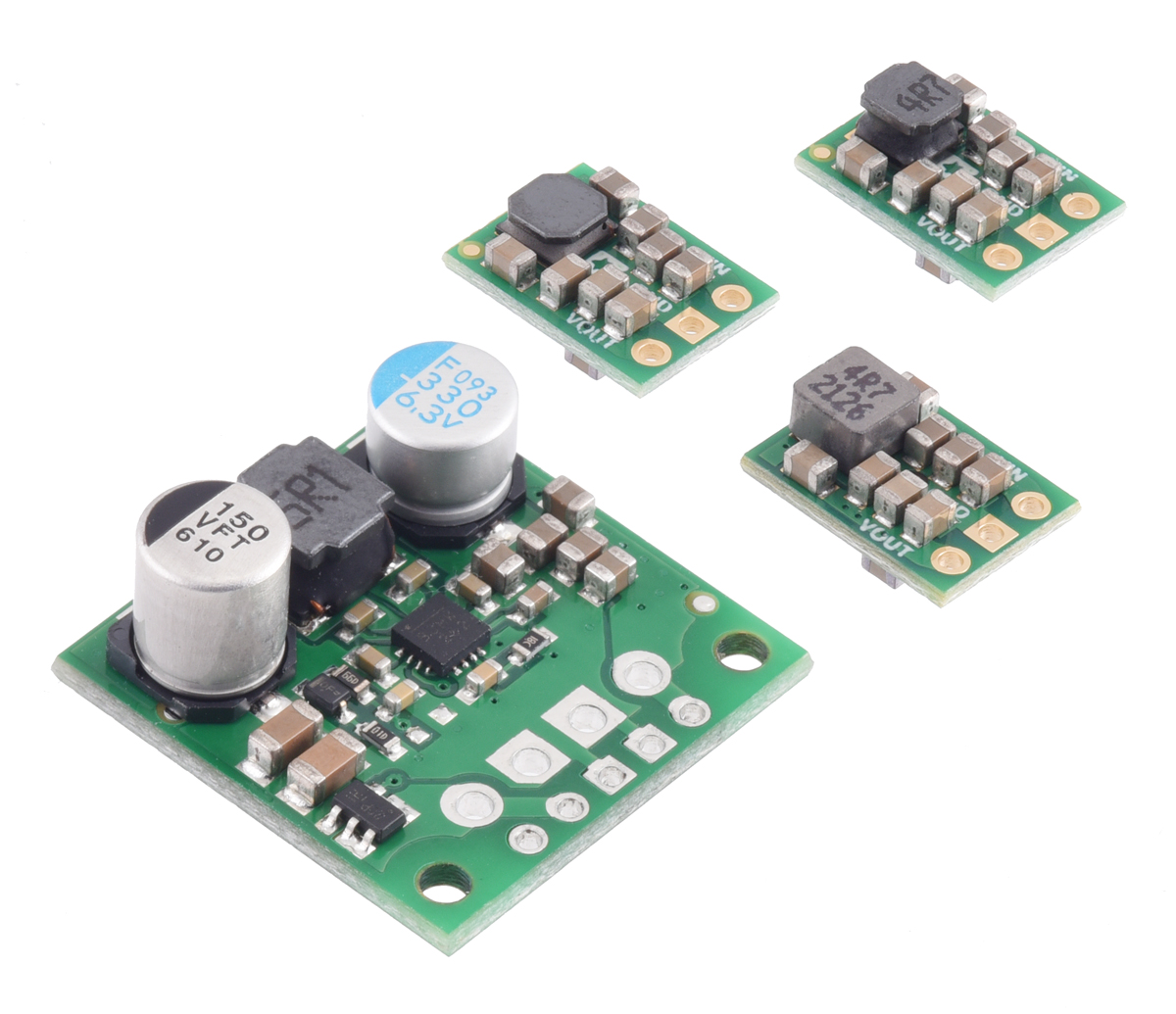
This family consists of the S13V30F5, which is a larger (0.9″ × 0.9″) high-current version:
and three extra-compact (0.35″ × 0.475″) lower-current versions:
The regulators have under-voltage lockout, output over-voltage protection, and over-current protection. A thermal shutdown feature also helps prevent damage from overheating and a soft-start feature limits the inrush current and gradually ramps the output voltage on startup. The larger 3 A S13V30F5 has reverse-voltage protection up to 20 V, but the S13V10F5, S13V15F5, and S13V20F5 do not.
 |
 |
3.3V Step-Up/Step-Down Voltage Regulator S13V25F3. |
|---|
The S13V25Fx family, which is pin-compatible with the S13V30F5, consists of six 2.5 A regulators with output voltages ranging from 3.3 V to 15 V:
These versions have the same overall board dimensions as the S13V30F5, but please note that the tall components (i.e. electrolytic capacitors and inductor) are in different locations.
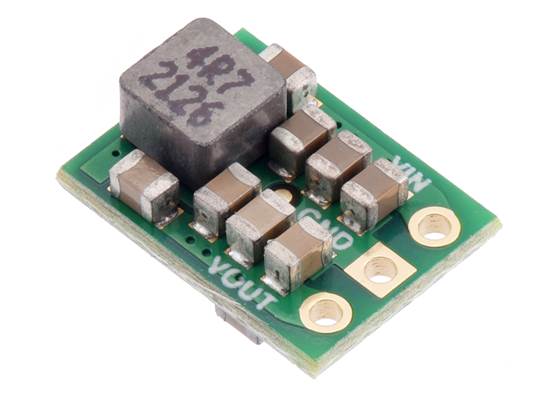
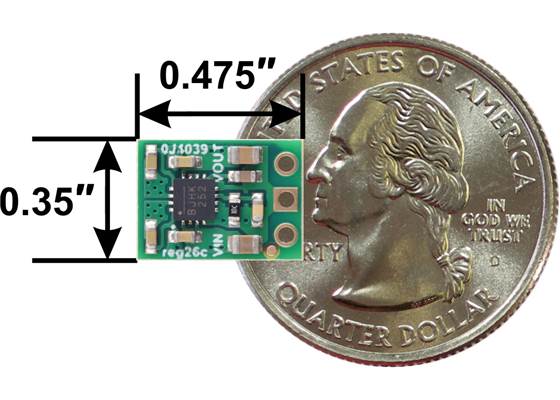
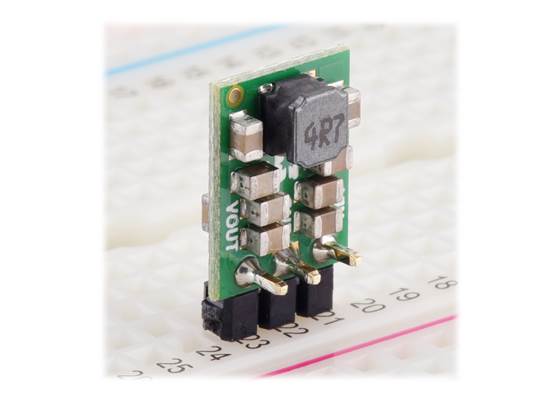
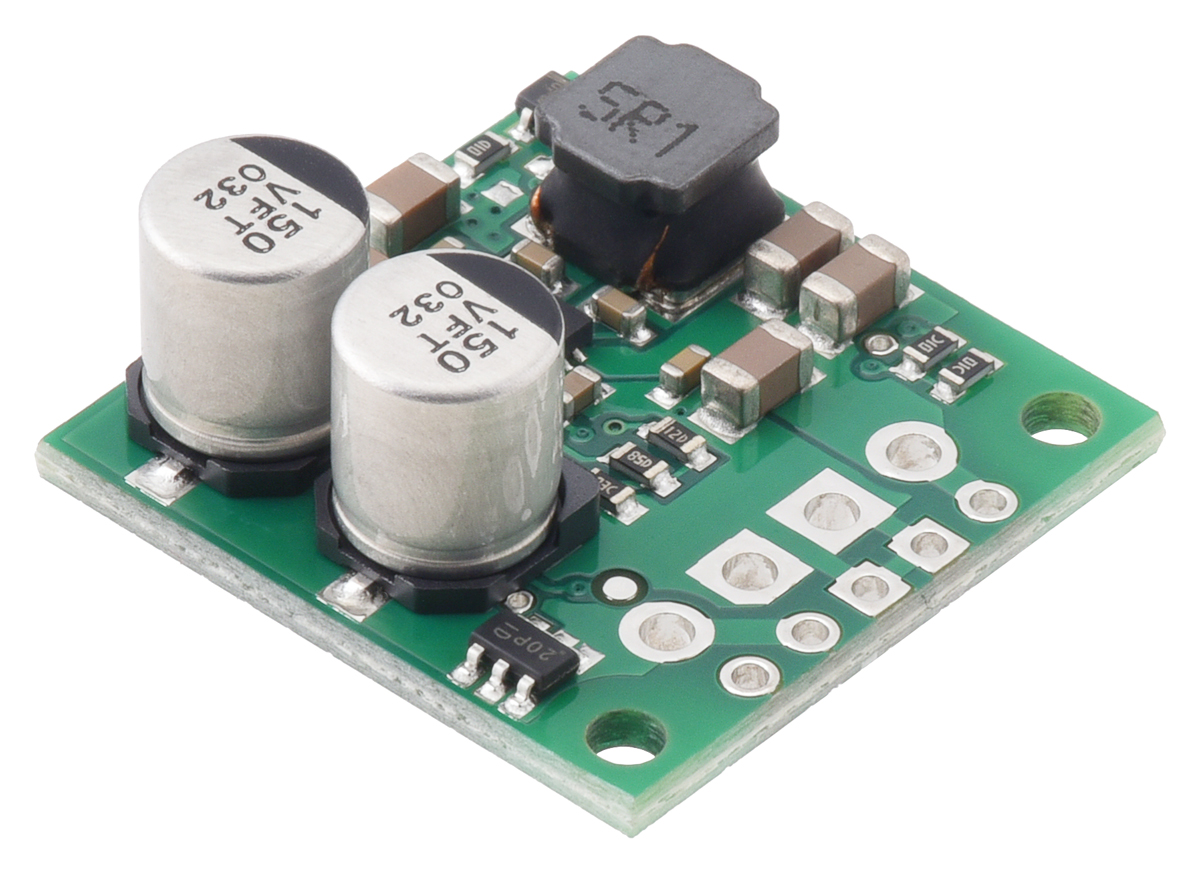
5V, 2A Step-Up/Step-Down Voltage Regulator S13V20F5, top view. |
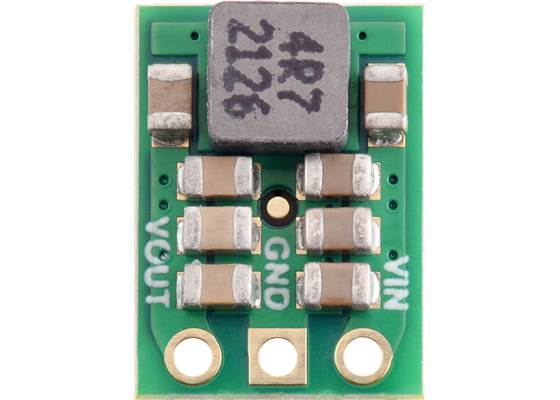
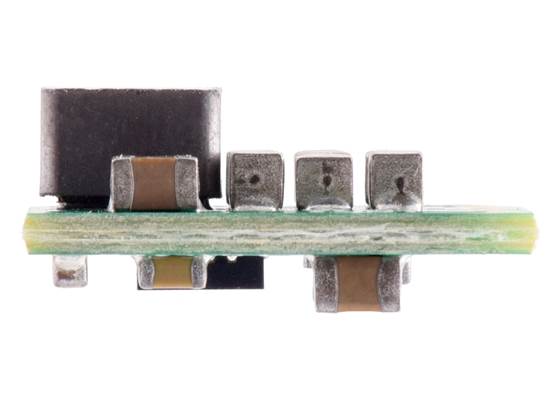
5V, 2A Step-Up/Step-Down Voltage Regulator S13V20F5, bottom view. |
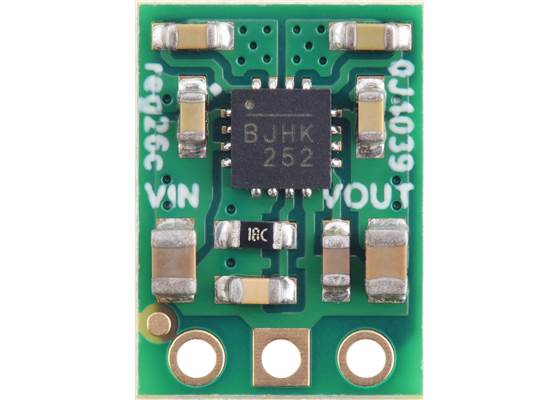
Note: This product is the 5V, 2A Step-Up/Step-Down Voltage Regulator S13V20F5. It can be distinguished from the similar-looking S13V10F5 and S13V15F5 by the inductor style, which is different for each of the three versions, and by the “reg26c” and “0J4039” markings on the PCB silkscreen (see the right picture above).
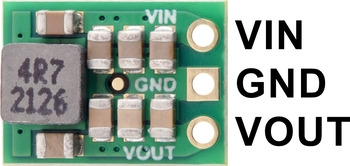 |
5V, 2A Step-Up/Step-Down Voltage Regulator S13V20F5 pinout. |
|---|
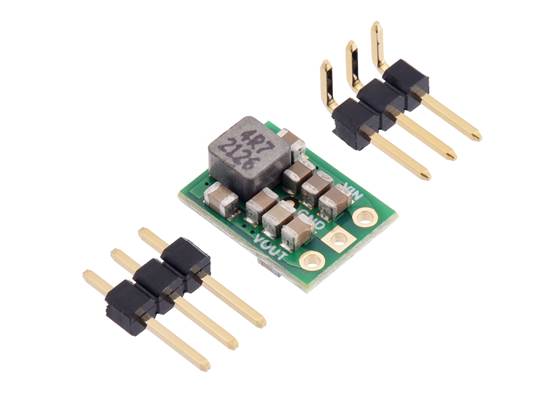
The step-up/step-down regulator has just three connections: the input voltage (VIN), ground (GND), and the output voltage (VOUT). The input voltage, VIN, powers the regulator. Voltages between 2.8 V and 22 V can be applied to VIN. VOUT is the regulated output voltage.These through-holes are arranged with a 0.1″ spacing along the edge of the board for compatibility with standard solderless breadboards and perfboards and connectors that use a 0.1″ grid. A 3×1 straight male header strip and a 3×1 right-angle male header strip are included, and you can solder in the one that gives you your desired board orientation. Alternatively, you can solder wires directly to the board for the most compact installations.
5V, 2A Step-Up/Step-Down Voltage Regulator S13V20F5, with hardware. |
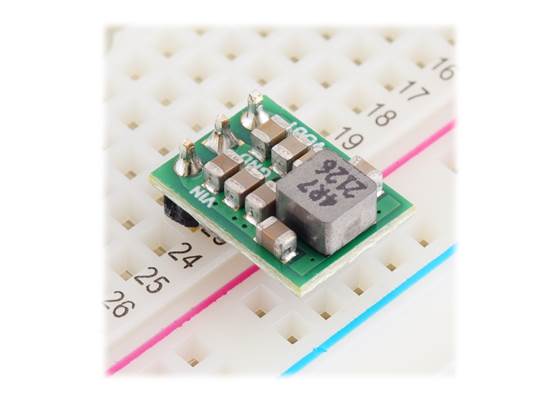
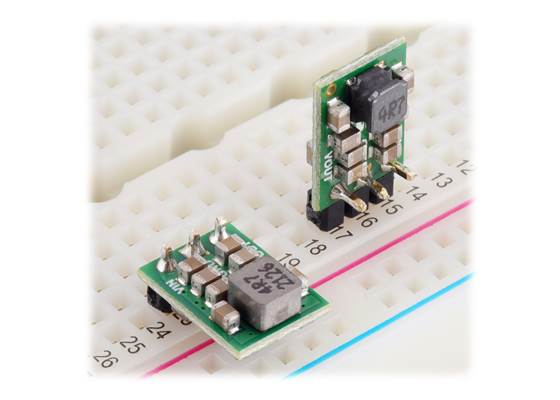
5V Step-Up/Step-Down Voltage Regulator S13VxF5 units on a breadboard. |
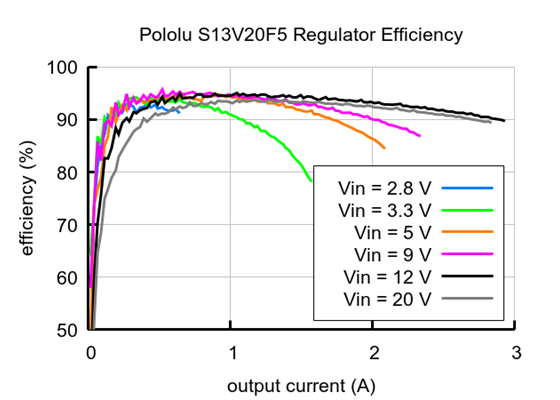
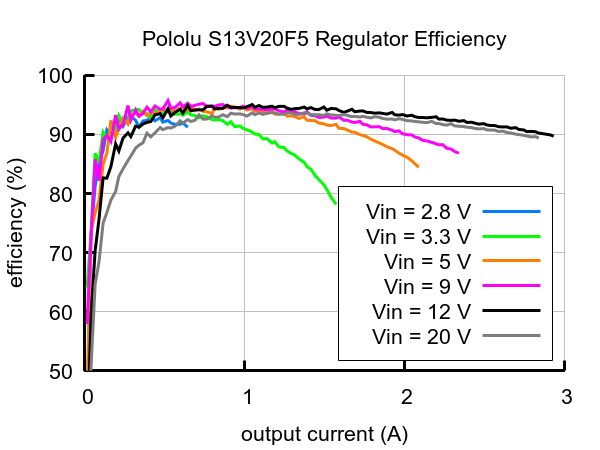
The efficiency of a voltage regulator, defined as (Power out)/(Power in), is an important measure of its performance, especially when battery life or heat are concerns.
 |
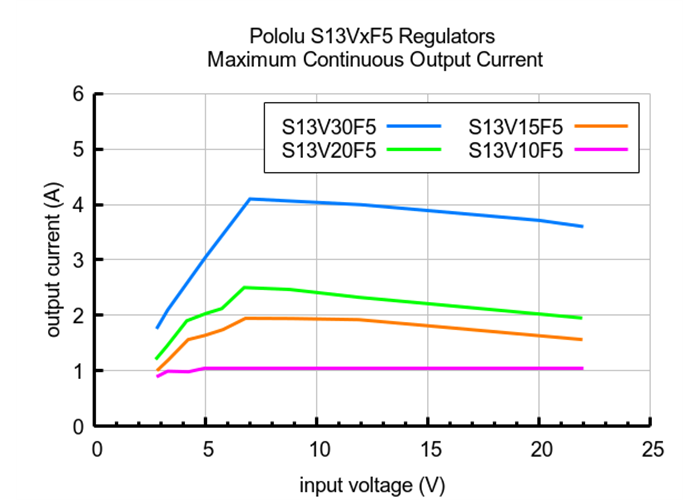
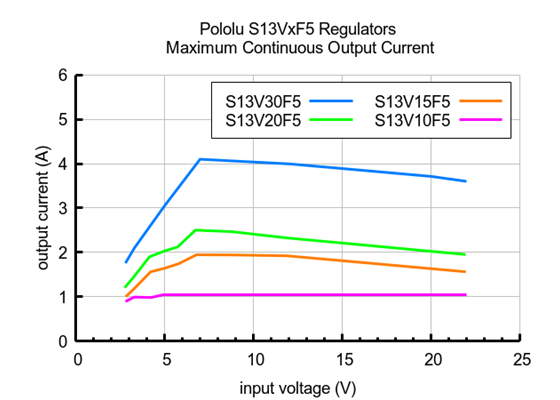
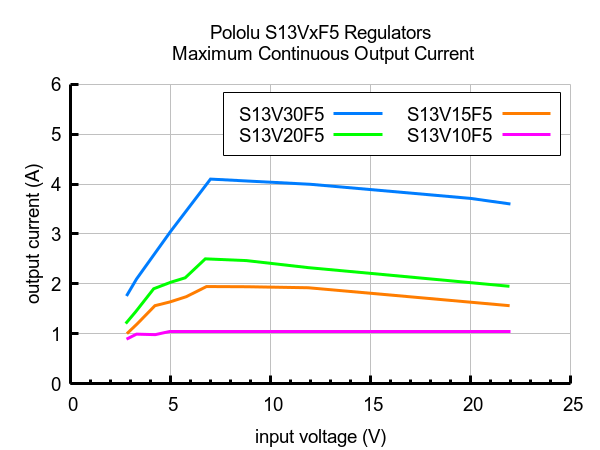
The maximum achievable output current of the regulator varies with the input voltage but also depends on other factors, including the ambient temperature, air flow, and heat sinking. The graph below shows maximum output currents that the regulators in the S13VxF5 family can deliver continuously at room temperature in still air and without additional heat sinking.
 |
During normal operation, this product can get hot enough to burn you. Take care when handling this product or other components connected to it.
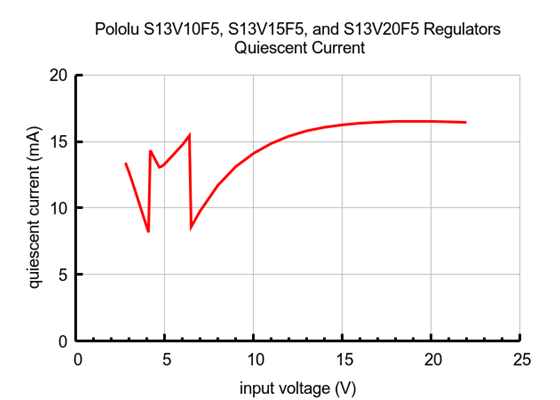
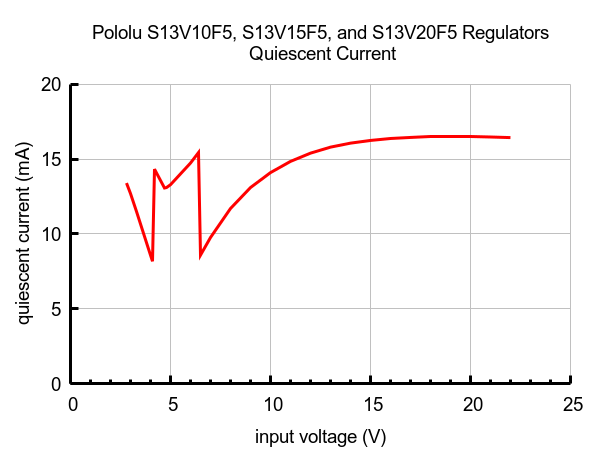
The quiescent current is the current the regulator uses just to power itself, and the graph below shows this as a function of the input voltage.
 |
When connecting voltage to electronic circuits, the initial rush of current can cause voltage spikes that are much higher than the input voltage. If these spikes exceed the regulator’s maximum voltage, the regulator can be destroyed. If you are connecting more than about 15 V, using power leads more than a few inches long, or using a power supply with high inductance, we recommend soldering a 33 μF or larger electrolytic capacitor close to the regulator between VIN and GND. The capacitor should be rated for at least 35 V.
More information about LC spikes can be found in our application note, Understanding Destructive LC Voltage Spikes.
| Size: | 0.35″ × 0.475″ × 0.22″1 |
|---|---|
| Weight: | 0.8 g1 |
| Minimum operating voltage: | 2.8 V |
|---|---|
| Maximum operating voltage: | 22 V |
| Continuous output current: | 2 A2 |
| Output voltage: | 5 V |
| Reverse voltage protection?: | N |
| Maximum quiescent current: | 20 mA3 |
| Output type: | fixed 5V |
| PCB dev codes: | reg26c |
|---|---|
| Other PCB markings: | 0J4039 |
This file contains 3D models (in the step file format) of the 5V Step-Up/Step-Down Voltage Regulators S13VxF5.
These DXF drawings show the locations of all of the holes on the 5V Step-Up/Step-Down Voltage Regulators S13VxF5.

 Brands