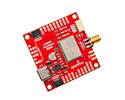
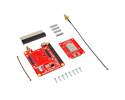
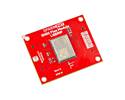
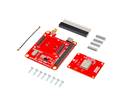
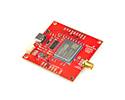
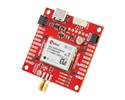
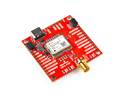
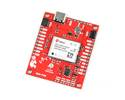
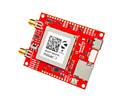
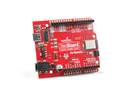
SparkFun Quadband GNSS RTK with Heading Breakout - LG580P (Qwiic)

The SparkFun LG580P Breakout is a quad-band GNSS RTK board that delivers centimetre-level positioning accuracy and instantaneous heading for advanced navigation and robotics applications.


Description

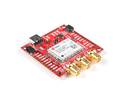
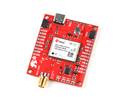
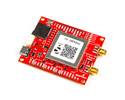
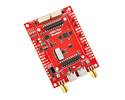
The SparkFun Quadband GNSS RTK with Heading Breakout is a powerful positioning and orientation solution built around the Quectel LG580P module. This board delivers centimetre-level RTK accuracy and introduces the game-changing ability to determine instantaneous heading. Designed with a similar footprint to our popular ZED-F9P breakouts, this board serves as a powerful upgrade, featuring dual antenna inputs and robust quad-band reception.

The Power of Instantaneous Heading

Traditional navigation systems need to move to figure out which way they're pointing, which is why your phone's navigation arrow often spins when you're standing still. The LG580P eliminates this problem. By using two GNSS antennae, it calculates your heading the moment it's powered on, without relying on previous movements. This immediate orientation is critical for autonomous driving, precision agriculture, and robotics, where knowing your exact direction from a standstill is essential for accurate operation.

A GNSS Technical Powerhouse

The LG580P is a quad-band, multi-constellation, high-precision receiver capable of simultaneously tracking signals from the L1L2L5, and L6/E6 Bands across the GPS, GLONASS, Galileo, BDS, QZSS, and NavIC constellations. It supports a full suite of correction services for maximum accuracy, including:

  • RTK and RTCM corrections
  • SBAS augmentation (WAAS, EGNOS, BDSBAS, MSAS, GAGAN, KASS, ASECNA, SouthPAN, and SDCM)
  • PPP services* (BDS PPP-B2b, QZSS CLAS, MADOCA-PPP, and Galileo HAS*)

This multi-band capability ensures fast convergence times and reliable, high-precision performance.

Built for Challenging Environments

The LG580P features professional-grade interference detection and elimination algorithms, effectively mitigating noise to improve signal reception in complex electromagnetic environments. The advanced RTK and heading algorithms ensure reliable positioning even in challenging scenarios, such as urban canyons or dense tree cover. With a high update rate of up to 20 Hz and low power consumption, this board is ideal for high-precision navigation applications.

Flexible Connectivity

Connecting to the LG580P is simple. The board features our solder-free Qwiic connectors for I²C* communication, and it also breaks out a variety of other interfaces, including UART, SPI, and CAN (See the UART Note at the top of this page regarding SPI and CAN interfaces).

*According to Quectel, support for the I²C interface is still under development and will be made available through a future firmware update. Additionally, the corrections for some of the PPP services (like HAS E6) have not been implemented yet.


Specifications

SparkFun Quadband GNSS RTK with Heading Breakout - LG580P Features:

  • Quectel LG580P quad-band, GNSS module
    • Concurrent signal reception: 5 + QZSS
      • L1, L2, L5, E6 frequency bands
    • GNSS Constellations:
      • GPS (USA)
      • GLONASS (Russia)
      • Galileo (EU)
      • BDS (China)
      • QZSS (Japan)
      • NavIC (India)
    • SBAS Systems:
      • WAAS (USA)
      • SDCM (Russia)
      • EGNOS (EU)
      • BDSBAS (China)
      • MSAS (Japan)
      • GAGAN (India)
      • KASS (Korea)
      • ASECNA (Africa)
      • SouthPAN (Aus/NZ)
  • Breakout board:
    • Dimensions: 1.70" x 1.80" (43.2mm x 45.7mm)
    • Four mounting holes:
      • 4-40 screw compatible
  • Connections:
    • 25 PTH Pins
    • 4-pin JST Qwiic connector* (x2)
    • UART interfaces (x3)
      • USB-C connector
      • 6 PTH pins (BlueSMiRF/Serial-to-UART)
      • 4-pin locking JST connector
  • LEDs:
    • PWR - Red 3.3V power indicator
    • PPS - Yellow Pulse-Per-Second indicator
    • RTK - White RTK correction indicator
    • HEAD - Green heading status indicator
    • PVT - Blue PVT status indicator
  • Backup battery
     

LG580P General Features:

  • High-precision RTK, and Heading GNSS module
  • Electrical Characteristics:
    • Supply Voltage: 3.0–3.6V
    • Current Consumption:
      • Normal Operation:
        • 98mA (323.4mW) (Acquisition)
        • 116mA (382.8mW) (Tracking)
      • Power Saving Mode:
        • 18μA (59.4μmW) (Backup Mode)
  • GNSS Frequency bands:
    • GPS: L1 C/A, L5, L2C
    • GLONASS: L1, L2
    • Galileo: E1, E5a, E5b, E6
    • BDS: B1I, B1C, B2a, B2b, B2I, B3I
    • QZSS: L1 C/A, L5, L2C, L6
    • NavIC: L5
    • SBAS: L1
    • L-band PPP*:
      • PPP: B2b
      • QZSS: L6
      • Galileo HAS: E6*
  • Tracking Channels: 1040
  • Horizontal Position Accuracy:
    • Autonomous: 1m
    • RTK: 0.8cm + 1ppm
  • Vertical Accuracy:
    • Autonomous: 1.5m
    • RTK: 1.5cm + 1ppm
  • Heading Accuracy: 0.1°
  • Velocity Accuracy Without Aid: 0.03m/s
  • Accuracy of 1PPS Signal: 5ns
  • RTK Convergence Time: 5s
  • Time to First Fix (without AGNSS):
    • Cold Start: 28s
    • Warm Start: 28s
    • Hot Start: 1.8s
  • Sensitivity:
    • Acquisition: -145dBm
    • Tracking: -160dBm
    • Reacquisition: -155dBm
  • Dynamic Performance:
    • Maximum Altitude: 10000m
    • Maximum Velocity: 490m/s
    • Maximum Acceleration: 4g
  • Update Rate:
    • Default: 10Hz
    • Max: 20Hz
  • Antenna Interface:
    • External active antenna
    • Power Supply: External
  • Interfaces
    • UART (x3)
      • Baud Rate: 9600–3000000bps
      • Default: 460800bps
      • Protocol: NMEA 0183/RTCM 3.x/QGC
    • SPI* (x1)
    • I2C* (x1)
    • CAN* (x1)
  • Operating temperature: -40°C to +85°C
  • Footprint: 21mm × 16mm × 2.7mm
  • Weight: 1.4g

*: Feature is still under development


Resources

Related Products