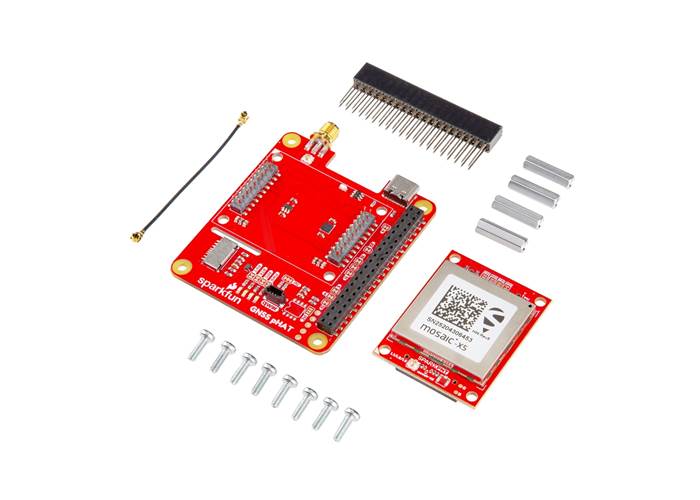
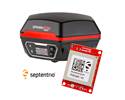
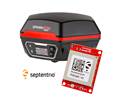
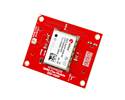
SparkFun GNSS Flex pHAT - mosaic-X5 & IM19 IMU

The ultimate all-in-one GNSS Flex pHAT, featuring the Septentrio mosaic-X5 and an IM19 IMU for survey-grade, millimetre-level RTK precision with full tilt compensation.


Description

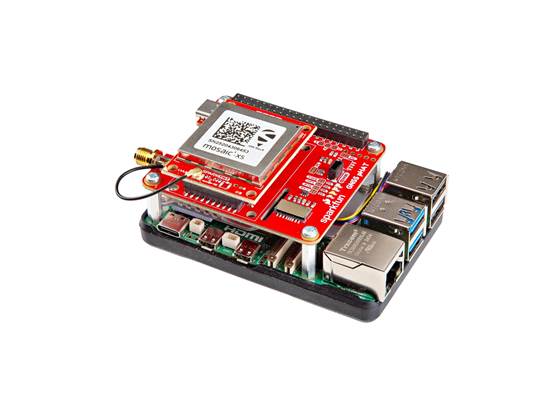
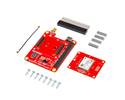
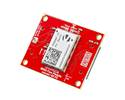
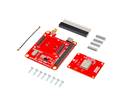
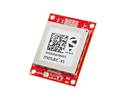
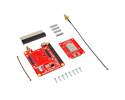
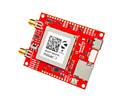
Achieve the absolute pinnacle of positioning performance with your Raspberry Pi using the SparkFun mosaic-X5 & IM19 IMU GNSS Flex pHAT. This is one of our most advanced GNSS receiver boards, combining the versatile Flex pHAT carrier with the industrial-grade, millimetre-level mosaic-X5 RTK receiver and the high-precision IM19 IMU. It's the ultimate all-in-one solution for professional surveying, industrial robotics, and critical autonomous systems.

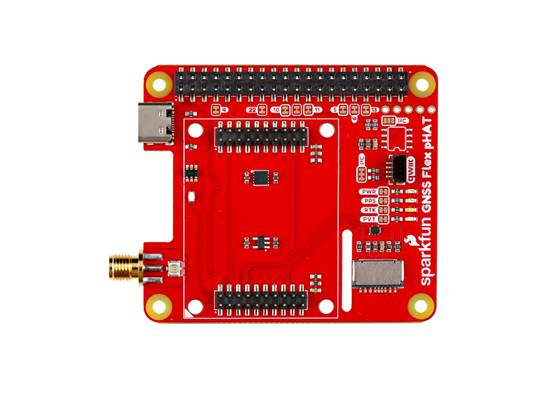
The GNSS Flex pHAT acts as the bridge between your Raspberry Pi and the modular SparkPNT ecosystem. It mounts securely via an extended 40-pin header and connects to the included GNSS module using standardized 2x10-pin headers.

  • Raspberry Pi Connectivity: Standard 40-pin GPIO header for a direct, secure connection.
  • Native USB Access: A dedicated USB-C port connects directly to the mosaic-X5's USB hardware for high-speed data access to its web server.
  • microSD Card Slot: Ideal for logging data on position, velocity, and time.
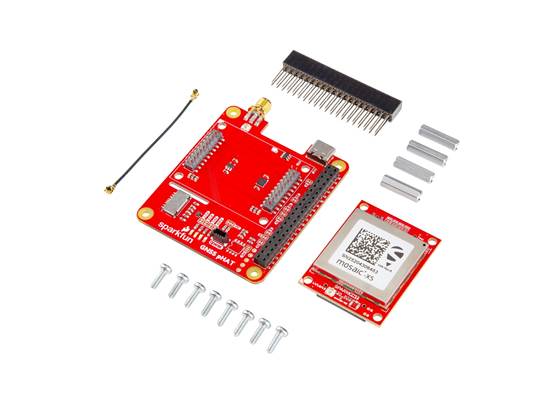
  • Mounting Hardware Included: Comes with the necessary standoffs, screws, and an extended header for a clean, stable setup.

Survey-Grade RTK Precision

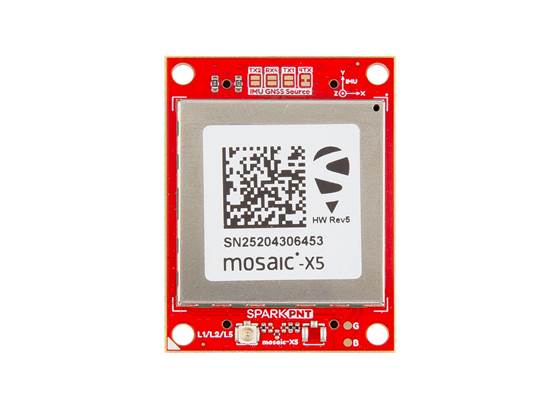
At the heart of this pHAT is the Septentrio mosaic-X5, a multi-band, multi-constellation receiver known for its best-in-class reliability and performance.

  • Millimetre-Level Accuracy: Delivers an astonishing 6mm horizontal and 1cm vertical accuracy with RTK, plus timing precision down to five nanoseconds.
  • AIM+ Interference Mitigation: Features Septentrio's unique AIM+ technology, a powerful anti-jamming and anti-spoofing system that ensures unparalleled robustness and reliability in noisy RF environments.
  • Multi-Band & Multi-Constellation: Tracks all signals from all major constellations (GPS, GLONASS, Galileo, BeiDou, NavIC) for maximum satellite availability and fast, reliable fixes.

Intelligent Tilt & Dead Reckoning

Paired with the mosaic-X5 is the Feyman (FMI) IM19 IMU, which combines MEMS sensor data with the GNSS RTK positioning data to provide high-precision attitude measurements. This enables advanced features, such as tilt-compensated surveying and robust navigation during brief GNSS outages.

  • Survey-Grade Accuracy: Delivers roll and pitch measurements accurate to within 0.05 degrees.
  • Tilt Compensation: No more perfectly vertical survey poles! The IM19 can calculate a virtual digital level point at any tilt angle, revolutionizing field data collection.
  • Sensor Fusion: Provides a continuous navigation solution (dead reckoning) even during momentary GNSS signal loss, perfect for urban or obstructed environments.

Intuitive Control & Seamless Integration

This Flex Module is engineered to provide both a sophisticated user experience and a tightly integrated navigation solution, setting it apart from typical receivers.

  • Browser-Based Interface: Access the mosaic-X5's powerful, built-in web server from any browser via the USB interface for intuitive setup, monitoring, and data logging.
  • Command-Line Interface: For power users and automated testing, a full Command-Line Interface (CLI) is also available for deep configuration and control.
  • Pre-Configured for Fusion: By default, the mosaic-X5's COM4 is linked to the IM19's UART2, automatically feeding it the necessary NMEA data. The IMU then outputs a fully compensated position and attitude. This link can be easily reconfigured via onboard jumpers to suit your specific project needs.

This pHAT requires an external antenna. Users have a few options for connecting an external GNSS antenna to their GNSS receiver.

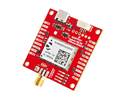
  • The included GNSS Flex module has a U.FL connector for an external antenna.
  • For a sturdier connection, the SparkFun GNSS Flex pHAT includes an SMA connector bridged to a U.FL connector. Users simply need to jumper the U.FL connectors on both the SparkPNT GNSS Flex Module and SparkFun GNSS Flex pHAT with a short U.FL cable.

This pHAT also requires a Raspberry Pi (or similar single-board computer). Users can find Raspberry Pi and NVIDIA single-board computers in our catalogue. By default, we use the Raspberry Pi's primary serial bus (i.e., TX: GPIO14/Pin 8; RX: GPIO15/Pin 9) to communicate with the GNSS receiver of the SparkPNT GNSS Flex module. However, users can also utilise any of the other interfaces.


Specifications

GNSS Flex pHAT:

  • 40-pin socket for Raspberry Pi header
  • 40-pin header for GNSS Flex modules
    • Two 2x20-pin, 2mm-pitch male headers
      • Power
        • 3.3V
        • Backup power
        • USB bus detect (not a power source)
      • USB data
      • UART (x4)
      • SD card
      • I2C bus
      • PPS signal (x2)
      • LED indicators (x2)
      • Event indicators (x2)
  • USB-C connector
    • Interfaces directly w/ GNSS Flex Module
  • Antenna bridge
    • U.FL connector
    • SMA connector
  • µSD card socket
  • Qwiic connector
  • Indicator LEDs
    • PWR (Red)
    • PPS (Yellow)
    • RTK (White)
    • PVT (Blue)
  • Twenty-four jumpers
    • Raspberry Pi GPIO isolation (x16)
    • LED power isolation (x4)
    • I2C pull-up resistors (x4)
       

mosaic-X5 and IM19 GNSS Flex Module:

  • Septentrio mosaic-X5 GNSS Receiver
    • GNSS Constellations:
      • GPS (USA)
      • GLONASS (Russia)
      • Galileo (EU)
      • BDS (China)
      • QZSS (Japan)
      • NavIC (India)
    • SBAS Systems:
      • WAAS (USA)
      • SDCM (Russia)
      • EGNOS (EU)
      • BDSBAS (China)
      • MSAS (Japan)
      • GAGAN (India)
  • IM19 Inertial Measurement Unit
  • Two 2x20-pin, 2mm-pitch male headers
    • 40-pin socket for GNSS Flex system
      • Power
        • 3.3V
        • Backup power
        • USB bus detect (not a power source)
      • USB (x1)
      • UART (x4)
      • SD card
      • PPS signal (x1)
      • LED indicators (x2)
      • Event indicators (x2)
  • U.FL Connector:
    • GNSS Antenna (Active, Multi-band)
    • 3.3V power for an active antenna
  • Dimensions: 44.0mm x 34.0mm (Approx. 1.73" x 1.34")
  • Four mounting holes: 
    • 4-40 screw compatible
    • Hole centers: 39.0mm x 29.0mm
  • Header spacing: 36.0mm  

Flex Module Interfaces:

  • USB: mosaic-X5 only (D+ and D-)
  • SD Card: mosaic-X5 only (CMD, CLK, and DATA)
  • Flex COM1: mosaic-X5 UART1
  • Flex COM2: mosaic-X5 UART2
  • Flex COM3: IM19 UART1 (TX and RX only)
  • Flex COM4: IM19 UART2 (TX and RX only)
  • PPS1: mosaic-X5 PPS
  • PPS2: N/C
  • EVENTA: mosaic-X5 EVENTA
  • EVENTB: mosaic-X5 EVENTB
  • RTK LED: mosaic-X5 GP_LED2
  • PVT LED: mosaic-X5 GP_LED

mosaic-X5 General Features:

  • Voltage Range: 3.135 to 3.465V
    • Max current: 500mA
  • RTK Accuracy
    • Horizontal: 0.6cm (±0.5ppm)
    • Vertical: 1cm (±1ppm)
  • Channels: 448 (simultaneous tracking)
  • GNSS Frequency Bands:
    • GPS: L1 C/A, L1PYL2C, L2P, L5
    • GLONASS: L1CA, L2CA, L2P, L3CSMA
    • Galileo: E1, E5a, E5b, E5 AltBoc, E6
    • Beidou: B1I, B1C, B2a, B2b, B2I, B3
    • QZSS: L1 C/A, L1 C/B, L5, L2C
    • NavIC: L5
    • SBAS: Egnos, WAAS, GAGAN, MSAS, SDCM (L1, L5)
    • L-band PPP
  • Time to Fix
    • Cold Start: < 45s
    • Warm: < 20s
    • Reacquisition: 1s
  • Timing Precision: 5ns
  • Update Rate: 100Hz
  • Latency: < 10ms
  • VANT Voltage Range: 3.0 to 5.0V
    • Max current: 150mA
  • Interfaces:
    • UART (x4)
    • Ethernet
    • USB device (2.0, HS)
    • SDIO (mass storage)
    • GPIO user programmable (x2)
    • Event markers (x2)
    • Configurable PPS out

IM19 General Features:

  • Operating Range:
    • Accelerometer: ±8g
    • Gyroscope: ±1000°/s -Accuracy:
    • Accelerometer Bias: ±5mg
    • Gyroscope Bias Accuracy: ±0.2°/s
      • Roll/Pitch: ±0.025° (1σ)
      • Heading: ±0.25° (1σ)
    • RTK: + 0.3mm/tilt°, with 200cm straight pole (1σ)
    • Auto Steering Yaw: 0.25° (1σ)
  • Initialisation: ~1s
  • Footprint: 14.8mm x 18.4mm

Resources

Related Products