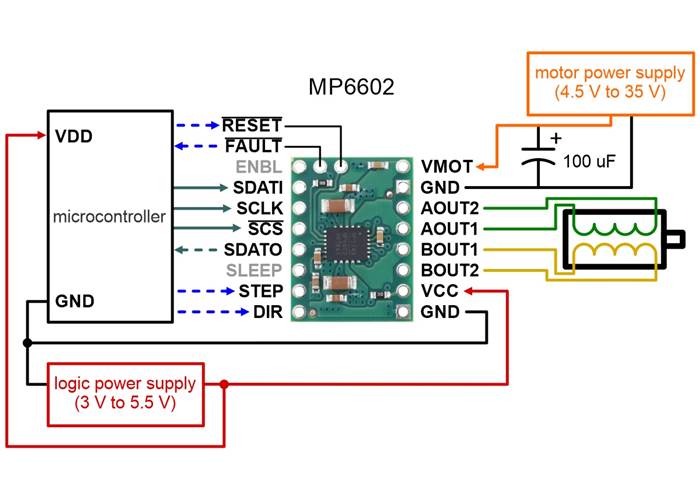
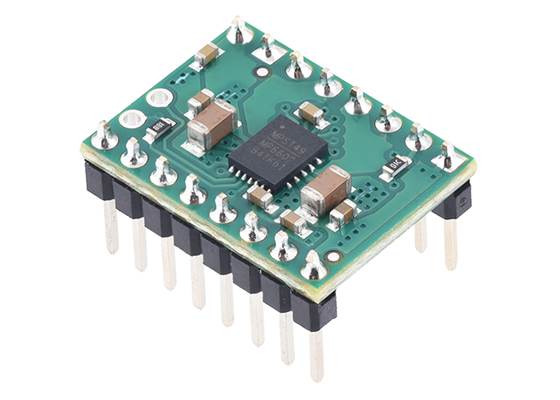
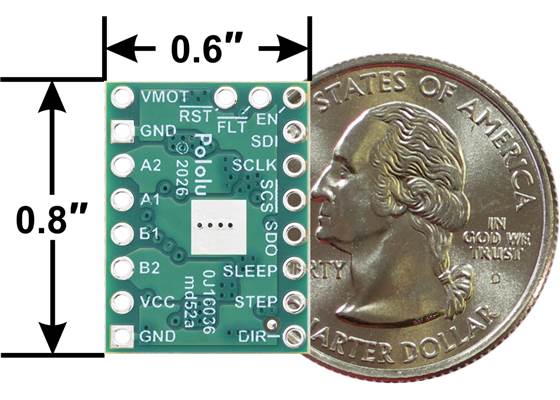
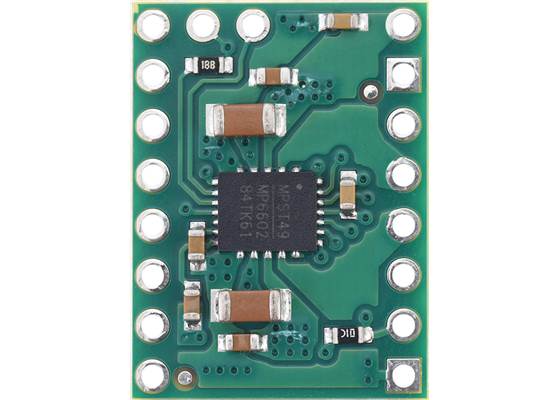
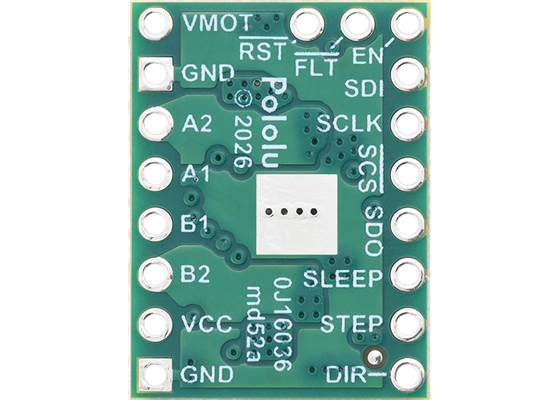
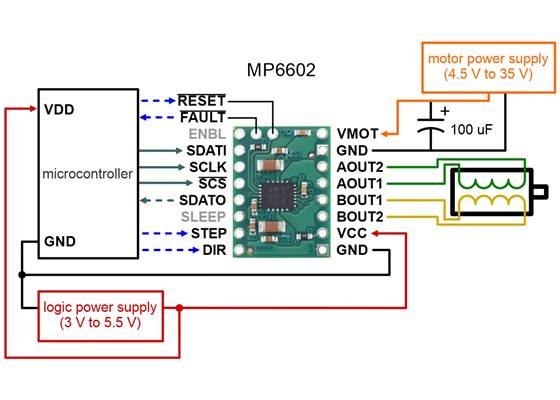
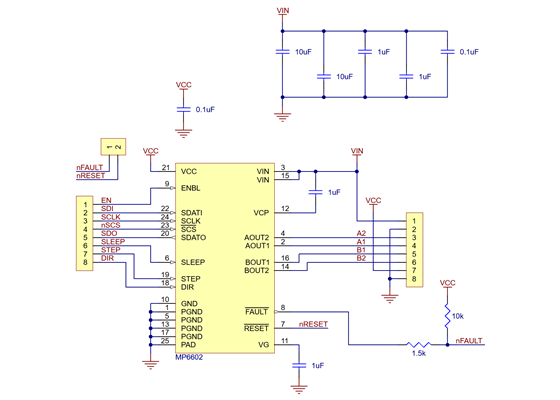
This version of our MP6602 Stepper Motor Driver Carrier ships with male header pins installed , so no soldering is required to use it with an appropriate 16-pin socket or solderless breadboard. Please see the MP6602 Stepper Motor Driver Carrier product page for more information about the driver.
Special Order
Shipping from $4.90
+298 more from our supplier in 7-10 days
Our Code: SKU-011382
Supplier Link: [Pololu MPN:5689]
This version of our MP6602 Stepper Motor Driver Carrier ships with male header pins installed, so no soldering is required to use it with an appropriate 16-pin socket or solderless breadboard. Please see the MP6602 Stepper Motor Driver Carrier product page for more information about the driver.
This version of our MP6602 Stepper Motor Driver Carrier ships with male header pins installed, so no soldering is required to use it with an appropriate 16-pin socket or solderless breadboard. Please see the MP6602 Stepper Motor Driver Carrier product page for more information about the driver.
| Size: | 0.6″ × 0.8″ |
|---|---|
| Weight: | 2.4 g |
| Minimum operating voltage: | 4.5 V |
|---|---|
| Maximum operating voltage: | 35 V |
| Continuous current per phase: | 4 A1 |
| Maximum current per phase: | 4 A |
| Minimum logic voltage: | 3 V |
| Maximum logic voltage: | 5.5 V |
| Microstep resolutions: | full with 70% current, 1/2, 1/4, 1/8, 1/16, 1/32 |
| Current limit control: | SPI |
| Reverse voltage protection?: | N |
| Header pins soldered?: | Y |
| PCB dev codes: | md52a |
|---|---|
| Other PCB markings: | 0J16036 |
This application note explains the MP6602’s advanced features (step mode, current limit, automatic hold, off time and blanking time, stall detection, and fault detection) and how to configure the internal registers to use them correctly.
This DXF drawing shows the locations of all of the board’s holes.
This is a library for Arduino that helps interface with an MP6602 stepper motor driver. It uses the Arduino SPI library to communicate with the SPI interface of the MP6602.
Yes. To avoid damaging your stepper motor, you want to avoid exceeding the rated current, which is 600 mA in this instance. All of our stepper motor drivers let you limit the maximum current, so as long as you set the limit below the rated current, you will be within spec for your motor, even if the voltage exceeds the rated voltage. The voltage rating is just the voltage at which each coil draws the rated current, so the coils of your stepper motor will draw 600 mA at 3.9 V. By using a higher voltage along with active current limiting, the current is able to ramp up faster, which lets you achieve higher step rates than you could using the rated voltage.
If you do want to use a lower motor supply voltage for other reasons, consider using our DRV8834 or STSPIN-220 low-voltage stepper motor drivers.
Yes, you do! Setting the current limit on your stepper motor driver carrier is essential to making sure that it runs properly. An appropriate current limit also ensures that your motor is not allowed to draw more current than it or your driver can handle, since that is likely to damage one or both of them.
Setting the current limit on the MP6602 is done through its SPI interface (this is very different from most of our other stepper motor driver carriers, which have their current limits set through their on-board potentiometers). The MP6602 defaults to a current limit of 1.25 A on start-up, which might be more than your stepper motor can safely handle, so we recommend setting current limit to an appropriate value for your stepper motor before enabling the driver outputs to prevent damage to the stepper motor. This is done by through the ISET register. The MP6602 datasheet (1MB pdf) and application note AN189 (1MB pdf) have more information on how to set the current limit through the SPI interface, and our Arduino library includes example sketches showing how to implement this in software.

 Brands