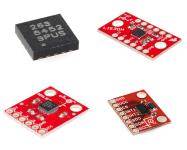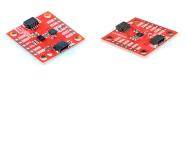
Movement sensors such as accelerometers and inertial measurement units provide data on motion and orientation. They support robotics, automation, sensing, and embedded projects by delivering motion, tilt, and vibration information that can drive control loops or log activity. Devices range from small breakout boards to compact modules with easy interfaces that plug into microcontrollers and single‑board computers, typically via I2C or SPI. Real‑world uses include bump detection, pose estimation, gesture sensing, and motion‑triggered responses.
Key capabilities include low power operation, reliable performance across temperature ranges, compact form factors, and straightforward integration with common development tools. Outputs can be digital or analogue, and many offer multi‑axis data along with basic fusion features to improve accuracy. Attributes to look at include data rate, interface type, power consumption, and how motion information can be fused with other sensors in a system.

 Brands